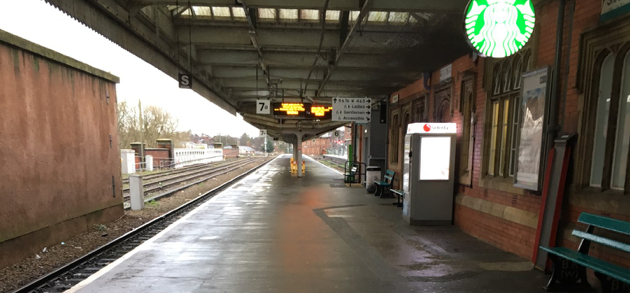
On a railway station, a small man stands hesitantly in the waiting area, a roughly rolled cigarette drooping from his mouth, his bag and coat piled roughly on the ground. He has a potbelly, is pale, not properly shaved and has a tag of skin on his right upper eyelid. He apologizes to me as I step inside, saying he’s not smoking in the enclosed space. He steps outside. I stand with him. I ask him how long he’s smoked. He tells me that he smokes less than he used to—twenty a day instead of thirty. He can’t give up, he says though he has tried—a number of times. He’s sixty-one and has in the last couple of weeks got a bus pass. He’s just used it to go somewhere to put a bet on a horse, and, he says he won £35 from a £20 bet. He’s catching the train now because he’s more certain of the times.
We talk about his mum who is in her late eighties, and his estranged step-dad who he hasn’t seen for twenty years. His mum, he says will do anything for him, though he’s not spoiled by her, he quickly points out. I say there’s nothing wrong with being spoiled by your mum. He likes the comment and we both laugh together. He has a box of chocolates in his bag to give to his mum tomorrow. We talk more; he’s very open. He’s in a home, a mental home of some sort. He has medication as certain times of the day and that means he can’t just get away for a cup of tea. That’s the reason he smokes, he says—it fits in with things. His step dad is ninety-four, but he hasn’t seen him for twenty years—he’s not allowed to. His step dad abused him, he says, physically abused he adds quickly but unconvincingly. They had argued, his step dad had been violent with him and thrown him out. He caught the train with the small amount of money he had and went to London. He had no money when he arrived so at the age of twenty had to live on the streets. He recited a list of streets and areas he had lived in. He told me about the misery of it, that every day he had just wanted to kill himself. He told me how unsafe he’d felt, how exposed to the world. After six months the police took him off the streets and he was put into mental care.
The whole period clearly lived with him as if it was yesterday, and not the forty-one years that it actually was. He was sad in a way though readily amused, gentle and gave out a feeling of kindliness. He stood by me waiting for the train then got into the door that we weren’t standing by and said an affectionate goodbye. I was very moved by his company and his story. I was affected by his openness and vulnerability. It was a beautiful, loving meeting.