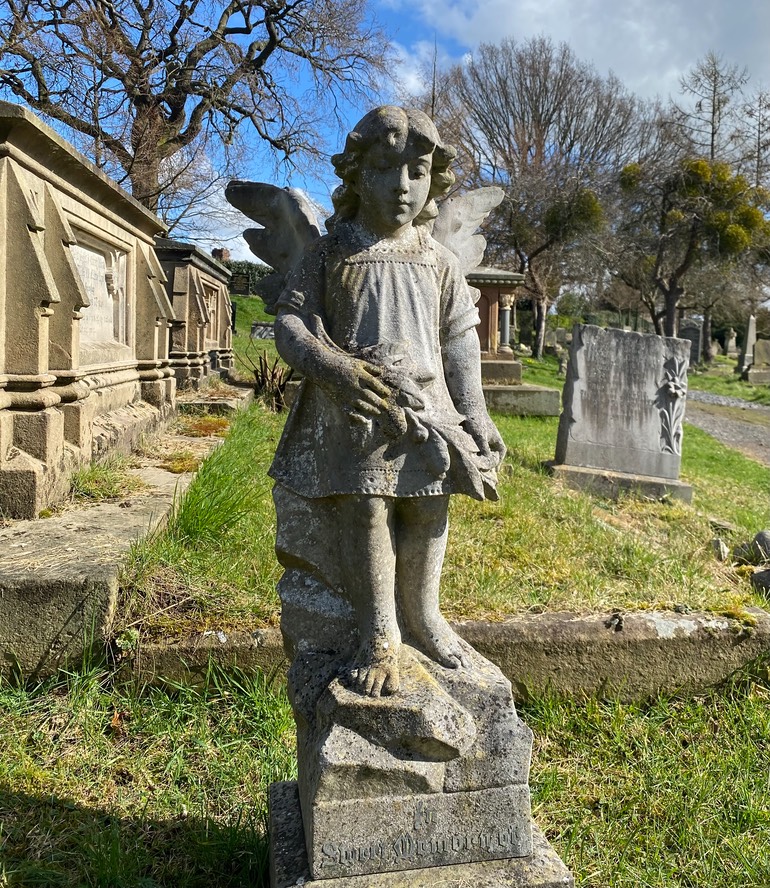
A-tishoo!
Ring-a-ring o’ roses,
A pocket full of posies,
A-tishoo! A-tishoo!
We all fall down.
‘Here you are, young man. Take a pinch.’
The old sexton holds out a small shiny box with a carefully worked, ivory inlaid top. He opens the lid and urges it towards me. I take some in between my thumb and finger, put it on the back of my other hand and sniff it up.
‘A-tishoo!’
Whenever I sneeze my mother always says, “A-tishoo! A-tishoo! We all fall down! Bless you, Mundie. Bless you a thousand times.”
‘A-tishoo!’
My mother is not here so I say it to myself.
‘A-tishoo! A-tishoo! We all fall down! Bless you, Mundie. Bless you a thousand times.’
Well, it’s a Saturday, and I’m in the church—the “place of worship”, as they call it. It has a high, arching roof closely panelled with dark maple boards. The floor is made of worn red tiles. The pews are heavy oak, their ends carved with swirling emblems and initials. Yes, and it’s a Saturday, and that’s unusual—Sunday is the day for attending the “place of worship”, not Saturday.
So, nervously—not having my mother’s hand to reassure me of things—I’m walking down the aisle. I make my way past the pew ends slowly, looking up each row and wishing that I could find a place on one of them to sit. There are so many people—far more than on a Sunday—and every row I look along is full. People bend forward and look back at me as I make my way. Some throw their eyes up, some squeeze their lips together, but none move up to make room and none smile. Yes, lots of people, nowhere to sit, no smiles. Whichever way I look—to my left, to my right—it seems as though the lines of the already seated congregation swells towards me, like a tide, filling any spaces between their bodies and blocking any opportunity for my admission to their ranks. I look left and the tide swells. I look right and the tide swells. I look ahead and sense the tide building ready to swell. I look behind and the swelling tide eases just slightly as though it’s mocking me, as though it’s daring me to turn back and try again. I don’t.
And, as I come close to the front, the massive stained glass window that towers behind the altar seems to grow in size. It seems to threaten me with its weight, with its caricatured images of conquering and defeat, with its shining portraits of armoured knights and glittering, clashing swords. Its images are filled with power and its imposition. Looking at it, I can think of nothing but battle, of pain, of victory and defeat. And yet I know nothing of these things. I turn slightly to the right and glare at the hymn board. It’s somewhere to rest my eyes—to look away from the threatening horror of combat and suffering.
There are four numbers on the board, each assembled from separate numbers placed on a sliding panel. When the hymn is announced to be sung a steward reaches up and moves the number panel from the left to the right. In this way the progress of the service is paced and its contents measured away. No hymns have yet been sung. My eyes fall on the first. Number 497. It doesn’t matter what the number is, to me it just announces entrapment. Yes, trapped by the process of it all: entering down the aisle, nowhere to sit, overcome by the unknown horrors of battle, waiting for a number that means nothing to me to announce the next phase.
I fall into thought. How have I come to be here? How long ago has all this been set in train? Has this Saturday morning been designed when the earth began? Was there something in its creation that determined my existence and this moment of it? I struggle in my mind for an answer. It’s like delving my hands into what I imagine might be newly-shorn fleeces—no shape, only the sensation of meaningless contact. How can this have been foreseen when it all began. There had been nothing church-like about the place in which it had all started. Ridiculous! And so long ago! Time! Confusion! Fleece!
I’m wearing a pair of loose-fitting, pink rubber boots no longer needed by an older cousin. ‘You’ll grow into them,’ my mother says with a smile as I look up to her, down to the boots, then up to her again in despair.
She says the same thing about a lot of my clothes. Yes, here I am, wearing the boots, in the graveyard with my mother—my adoring, joyful, young and beautiful mother. She holds my hand as we go through the ornate iron gates. She squeezes it. I squeeze hers back. I feel safe knowing she’s there—always I feel safe, knowing she’s there; always I hope she will always be there.
‘Come along, Mundie,’ she says. ‘And make sure you behave.’ Her voice is so sweet, so disarming, so loving.
‘Of course, Mother,’ I say as I welcome her towing me along.
My name is Edmund, by the way. “Mundie” is the pet name my mother uses for me; no one else calls me that.
We come here every week—my mother and me. She calls it “the cemetery” but to me, because of what it contains it’s “the graveyard”. We enter through huge, decorated cast iron gates supported on massive hinges attached on either side to two ornately constructed columns. The columns and the gates are embellished with strange shapes and figures of serpents and beasts, all of which are intertwined and woven together. I always crouch a little when we enter, feeling as if the figures of iron could drop onto me and wind me up in their reaching arms and serpentine tails. Sometimes my mother will stop and speak to a woman leaving through the gates. I will stand and wait, relieved to delay having to pass through them, while the women nod and point and sometimes find amusement in their exchange. As I wait I might test my courage by pressing my fingers in between the shapes on the columns only to pull them out quickly as I imagine them being bitten off by the monsters penned within their massive cage.
Before we enter we must pass beneath the sign that spans the gates. I tremble every time at its motto—“Closed during the hours of darkness”. It’s as if darkness descends from it; drips from its letters: closure, death, loss of everything known.
Once we’re through the gates my mother speaks more quietly, and in an unusual and strangely reverent tone. I think of it as her “cemetery voice”. Sometimes she turns and says to me ‘Shh, Mundie,’ as if there’s someone listening who might be disturbed. As if that could be, in the place inhabited only by those with forgotten memories.
Lots of bodies are buried here, in this graveyard, this cemetery—that’s what it’s for, of course; to contain the dead. Sometimes we see a funeral taking place: the black coated mourners, the coffin, the bowed heads, the wiping away of tears. The graves we visit are those of my mother’s mother and father, and her mother’s mother and father. We come here regularly to “water the graves” as my mother puts it. Yes, we water these places where they lie, these people with no memories, these bodies, in coffins with their arms folded across their chests waiting thirstily for refreshment.
My mother holds my hand more tightly as we move further in amongst the ranks of tombstones. There’s a small cleared area near the centre of all the walkways that spread throughout this labyrinth and we always make for that first. A large tank of water sits raised up on bricks at its centre. It’s made from corrugated metal and painted dark green. There’s a large brass tap near its base. Alongside it is a rack of hooks from which hang small green watering cans. My mother lifts two cans from their hooks and hands one to me.
‘Now, Mundie, we must get on with our job. Here, you fill both the cans.’
‘Yes, mother,’ I say and hold the first can beneath the tap then turn it until the water flows. I never let it overflow. I place the can down and do the same with the next.
Now we have both cans filled and we carry one each to the grave we always stop at first. This is the grave of my mother’s mother and father. I never knew them—they died before I was born. I don't understand why they are both in the same grave but I imagine that they must have died at the same time. I clutch my mother’s hand.
When I’m here I always think of what lies beneath the mounds of earth. I always think of those buried in the ground, turning their faces up and opening their mouths in the hope of drinking some of the water that we will pour onto the weak and fading flowers above them.
My mother gets down onto her knees and waves her hand to me to do the same. She drops her head and starts muttering a prayer. I wait. It sounds as if she’s humming a sweet tune. After a while, she stands and starts reading the inscription on the heavy grey stone at the head of the grave. ‘Forty eight,’ she murmurs slowly, then ‘Fifty one.’ I stand and watch. Sometimes she cries as she does this. I always look away if this happens. Today she doesn’t cry. When she’s finished looking and reciting the two numbers, she turns to me and nods her head urging me to start the watering.
‘Be careful not to tread on the grave, Mundie,’ she says. ‘Make sure you walk around it—just in case.’ She says the same thing every time. I daren't ask her what she means by “just in case”.
There are delicate flowers planted in a small circle on the mounds that extend from the inscribed headstones, and those are what we’ve come to water. I start the task, making sure that I stand well back for fear of treading on the mound of the grave—“just in case”. As I lean forward, the wear-worn soles of the rubber boots slip. I overbalance slightly and I tip my can too far. Water gushes out of the spout and knocks down some of the smaller, weaker flowers. I drop the can and hurriedly get down on my knees. Frantically, I try to bring the flower stems up straight again but it doesn’t work. Every time I touch them they bend more weakly and stick to the mud that the water from the can and the soil of the grave have made. I feel confused and panicky.
My mother quickly sees what’s happening and reaches down to save me.
‘Come along, Mundie,’ she says softly. ‘Don’t worry. The sun will dry them. Let’s go and do the old one now.’
I grab her hand. I’m still trembling. She pulls me up and we set off. We fill our cans again at the water tank as we make our way along the paths to the “old one”.
The tombstone here is larger than the other. And the inscription has weathered away to such an extent that it’s no longer readable. All I can see is a blurred remnant of the once carefully made carving. This time my mother says no numbers. She holds the palms of her hands together and, still standing, she closes her eyes and starts praying.
She does not invite me to join in; this is for her alone.
I look around as I wait.
On the far side of the graveyard from the main entrance, a narrow gate leads to a church. Its main entrance is through a lichgate covered with a tiled porch underneath which are seats on either side. Mother says that they rest the coffin there sometimes when they have to wait for the preacher to arrive. The church is built of heavy red sandstone blocks. At its one end a round tower is topped by a raised copper covered dome that shines a bright blue-green on sunny days. When we are filling our watering cans I try to look up to its top but, especially when there are clouds moving in the sky, I can’t focus. It makes me feel dizzy and I have to look away. Once I caught a glimpse of someone standing on the top of the tower. I felt a surge of fear run through my body as the figure stood unprotected on the exposed edge. There are times when a bell sounds from the tower, and when it does it always makes me jump. I’ve heard it often on our visits but still it always surprises me. My mother laughs at me when this happens and usually lurches at me pretending to be a fierce animal and tickles me. Then suddenly she seems to remember where we are and what’s expected from being here and she stops and returns to her quieter more respectful self.
She’s still praying. I’m staring at the church. I imagine the bell high up in its tower, suspended on its heavy beam yoke, its clapper hanging in its mouth, ready for the rope to be pulled to set it alive. My mother calls it the “corpse bell” as she says it’s rung every time a body is brought into the graveyard.
Suddenly, it chimes—a heavy, clanking, reverberating clang.
I jump and straightway my mother abandons her prayer, reaches out her fierce-animal fingers and growls at me.
It chimes again. I’ve never heard it do this before—a second time—and I’m thrown into confusion. I jump back and drop my watering can. My mother lifts her hands and again makes them into the claws of the fierce animal. She growls and contorts her face. She leans towards me and snarls loudly.
‘Grrr! Grrr! I’m the fierce animal, little Mundie! And I’m coming to get you! Grrr! Grrr!’
I fall back. She crouches down, then launches herself at me and drives her fingers into the sides of my ribs.
‘Grrr! Grrr! I’m coming out of the ground to get you, little Mundie!’
I explode with laughter! I’m overcome by her love, her attention, her playfulness. From the ends of her fingers it penetrates me and I’m warmed right through by it. My mother fills me with a deep sense of safety and, as long as she’s there, I know I have nothing to fear.
Suddenly she breaks off. She raises herself up on her toes lifts her hand up as far she she can and waves to someone. I look in the direction of her wave and see who it is that’s caught her attention. It’s the old sexton’s wife. She too is standing up on her toes waving. She’s dressed in heavy black clothes the skirt of which reaches the ground. No words pass between them but the waving changes into a beckoning and this causes my mother to go towards her. She glances back at me.
‘You wait here, Mundie. I won’t be long. Don’t go wandering off, now.’
‘No, Mother.’
I watch her approach the old sexton’s wife. They nod to each other in greeting. I can hear them chattering but I can’t make out any of their words. When this sort of thing happens I know it’ll be a while before my mother returns. Sometimes, if I’m closer, I hear the conversation that she has with other women. It’s often about people who have died or are ill and they describe at length the details of their ailments and diseases.
I look around. Only a few graves away is a large old stone with a small angel statue on its top. Sometimes, from behind this “angel stone” as I think of it, I’ve seen a young girl bob her head up and, when she realises I’ve seen her, she ducks back down again. Whenever we come here I always look out for her. Today there’s no sign of her.
I look across to my mother and the old sexton’s wife—they’re deeply engaged in their conversation. I take a step towards the angel stone. Again I look towards my mother and the old sexton’s wife. They’re both clearly enthralled by what they’re talking about. I take another step. And another. I’ve never been this close before. The statue of the angel has come slightly loose on its mount and it hangs crookedly, its head pointing towards the grave as if it’s praying. The grass on the grave mound behind it is flattened and smooth. I imagine the young girl has been sitting there. I look around foolishly, hoping that I might see her. I look down again at the flattened grass where I imagine she must sit. How long is it since she’s been here, I wonder. Do we leave a permanent trace of where we’ve been, I wonder.
Alongside, another grave has recently been dug. The webbing straps that lowered the coffin are still spread out on either side. Two timber beams span the width of the grave near each. A long-handled digging spade has been left lying on the ground. I check first that no one can see me, then I creep up to the side of the grave and look down into it. I’ve never seen a coffin this close before. It’s made of pale, bright wood with shiny brass handles, two on either side. It’s not as deep down in the grave as I imagined it would be. I grab the spade and, not knowing what has possessed me, or where I’m finding the daring from, I drive it into the ground as if I’m excavating a grave. The spade blade penetrates the soil easily. I don’t dare lift any soil out but the digging action is enough to thrill me.
I look around as if in fear of being seen. My mother is still deeply engaged in conversation. I drive the spade in again. And again for a third time. This time, as I try to get extra purchase using my feet, my boots let me down and I slip and fall. I hold on tightly to the spade handle as I drop down the side of the grave and fall with a crash onto the edge of the coffin. I want to scream but I daren't be discovered so I stifle the sound of my fears. I claw at the sides of the grave. Soil falls around me. I think I’m going to be buried. Desperately, I reach the spade blade up and hook it over one of the wooden beams. I pull down against it and try to pull myself up. It’s a frantic effort. It isn’t working. I kick the side of the coffin—again, and again.
Suddenly, I feel the lid dislodge.
I’m overcome with fear. I kick out frantically in every direction and the lid drops sideways. Still hanging onto the shaft of the suspended spade I can’t stop myself from looking inside. I gasp at what I see: the puffed, pale face of a woman in a white dress. One hand lies across her chest, the other must have been moved by my frantic kicking and hangs over the side. It’s as if she’s trying to climb out.
I can’t hold back. Whatever the outcome, I don’t know what else to do but scream.
‘Help! Help!’ I shout. ‘Help! Help!’
I kick and scramble frantically, struggling all the time to pull myself up on the shaft of the spade, all the while unable to stop myself looking at the woman in the coffin.
A face appears above me!
‘What’s happened to you, Edmund?’ Says the calm voice of a man. ‘Here, take my hand.’ It’s the old sexton. ‘Here. Grab hold. Let me help you. That’s no place to be for a boy who’s wearing such lovely boots.’
He stretches his hand down to me. I’m shaking with fear but nevertheless I manage to take it and hold on. He pulls and, first kicking against the dislodged top of the coffin and then the muddy and crumbling sides of the grave, I struggle up and fall onto the ground above.
Shaking all over, I stand up. I look at my rescuer.
‘I’m so—’
‘There’s no need to be frightened, Edmund.’
I turn to look back down into the grave.
‘She’s dead! Dead!’ I don’t know what else to say. There is nothing else in my mind.
I stare at him vacantly.
‘Here, have a pinch of snuff.’
‘Snuff?’
‘Yes. It’ll make you sneeze.’
I’m not sure I want to be made to sneeze.
‘Like this,’ he says taking some between his thumb and finger, spreading it on the back of his other hand then sniffing it up his nose.
He sneezes.
Hesitantly, I do the same.
‘A-tishoo!’
We both laugh.
‘It looks as if you’re trying to take over my job! Here.’ He’s reaching down to the spade that’s still hanging from the cross timbers into the grave. He pulls it free and puts it over his shoulder. My hand is shaking as he grabs hold of it. ‘It’s a scary thing you’ve done, my lad, that’s for sure. But you’re young, and I can remember when I was young like you. And I think, by the look of it, you’ve got the makings of a good gravedigger.’
He smiles.
‘Thank you, sir. Thank you.’
‘Now cut along. I’ll sort this out. Get back to your mother before she finds out.’
‘Yes, sir. Thank you, sir.’
He clambers down into the grave.
I turn and scramble away. I pull my way past the angel stone. The words on it are almost all worn away. I see my mother and run over to her. She’s just walking away from the old sexton’s wife.
‘Mundie! What have you been doing?’ she asks as I come up close to her. ‘Anyone would think you’d been scrambling down a grave! And look at your boots? We’re going to have to give them a good shine.’
She laughs, makes a funny face, takes hold of my hand and, with my boots caked with mud, we walk towards the entrance gates. As we pass the angel stone I catch sight of the girl as she ducks down to hide herself.
All this has set me thinking, as if I don't do enough of that anyway.
I can’t easily remember some early parts of my life. It’s all been so long ago—so distant. I’d certainly been a child—of that I’m sure—but what that childhood had constituted I’m not so sure. I felt unknown by the world, somehow born into the glare of anonymity. The only one who knew me was my mother.
Oh, my mother.
My mother, I remember, of course, though not so clearly as I would like. She had led me between the trees of the local woods, held my hand as she’d pushed her way through the crowds in the market. But all so long ago. Now, sometimes I can’t even easily conjure up an image of her face. I can remember her last words though—so clearly. Yes, those words, those final words are burned into my mind.
She lay there, reaching her arms out to me, drawing me closer, ever closer until I could feel her lips against my ear.
‘I love you, Mundie. I love you so much. Bless you, Mundie. Bless you a thousand times.’
My dear mother.
How I wish I could take her hand again. How I wish I could be led by her again. How I wish I could be lifted up in her enfolding arms as I was when she saw me again after I’d been playing alone, or after I’d been to church, or when I’d returned relieved from school. Ah, to be found again by my mother. I remember feeling lost when away from her, and found again when once more she took me up in her arms and squeezed me with delight. Oh, how I felt that delight.
‘Mundie!’ she would shout. ‘Oh, Mundie! You are my treasure! You are my gold and my jewels. I could squeeze the breath out of you!’
And she would! And then she’d stop and she’d squeeze me again. And I’d gasp with delight.
And those times in the summer when she would take my hand and lead me down the winding path to the beautiful river-pool—deep, clear-water, edged on three sides by smooth, light grey rocks and fed by a never-exhausted fall of water from the edge of the small crag that rose from its fourth side.
‘First, we must get you washed!’ she would say. ‘Come on, Mundie! Be sharp!’
And she would stand me beneath the waterfall, and she would rub her hands through my hair as the deluge drenched me from above. And then, without warning, she would throw off her clothes and launch herself forward and swim in the pool. And she would turn and wave to me, encouraging me to do the same. And I would enter the water nervously. And she would hold me and try to teach me how to swim. And she would laugh with me when it went wrong and I splashed about frantically trying to keep my head above the surface of the delightful water. Yes, held in my mother’s arms.
But yes, so long ago. Yet I can still imagine her laughing, playing jokes on me, looking serious as she tickled me until in the end I exploded into uncontrollable laughter. And I remember running to hide as she counted with her hands against her eyes, and being surprised when suddenly she found me. So long ago. And yet, like everything passed and remembered, so strangely close and clear.
‘Why are you frightened of the tower?’ she asked me one day when we were visiting the graveyard. I’d said I didn't know, but she knew I was not telling the truth. ‘Come along, Mundie. We can't have you frightened of things. We need to make you better. Tell me.’
I didn't really want to tell her, and now, so much—oh, so much—I wish I hadn’t; but at the time I knew I couldn’t get out of it.
‘It was like this,’ I started. She took my hand and sat me down on an old bench. ‘It was a day when I was not with you. I was running in the churchyard. Yes, running. I’m so sorry, Mother. I was just enjoying the day. And this time I didn't intend falling into any graves. And, anyway, it’d been a long time since I’d had those slippery-soled boots!’
She smiled lovingly.
‘Yes, my darling. Go on.’
I continued.
‘There were several of us, all boys, chasing each other, picking up clods of soil and throwing them at each other, yelling and calling out meaningless things to each other. I know I shouldn’t have, Mother. I know. I was not thinking. ‘Here!’ shouted someone. ‘Catch this!’ shouted another. ‘Ha! Got you that time!’ shouted another. Everything we did was dictated by and because of each other. Everything I was, was because of others. It was very different from when I come here with you, Mother—there was no quietness of speech, no respectful manner, no prayers, no sense of duty. And as we, this group of others, chased between the gravestones erected to mark the death of those who are now without days, I caught a glimpse, of one sitting amongst them who was different. It was the girl I’d sometimes seen before. She crouched behind the angel stone, giggling and tossing her hair from side to side as she watched us. I stopped and stared at her. She saw me looking and ducked down.
That day was so sunny. Yes, everything that was happening on that day was happening under the sun, Mother: the joy of being, the beautiful young girl.
‘Come into the tower!’ someone shouted. ‘Let’s see what we can see from the top!’
I felt immediately afraid. I knew the tower frightened me; the very sight of it, its height, its unguarded top filled me with a deep fear.
‘Come on!’
‘Come on!’
The pressure was so great—all of the others pursuing the same aim. I felt it as if it was something heavy pushing against me. I couldn’t stand against it. But I couldn’t follow. I was ready to run away. That was all I could think of doing. Then again I saw the girl as she appeared once more from behind the tombstone. She threw her hair to one side and smiled at me. Now I could do nothing. I was frozen.
‘Come on! Let’s get to the top and walk around the edge!’
‘Come on!’
The girl’s smile was burned into my mind. It was controlling me. I needed to act. I nodded to her and she tossed her hair to the side and smiled again.
That was it. I chased with the rest of the boys into the entrance at the base of the tower. It was dark inside. A ladder ran from the ground up to a chink of light at the top. High up, the single bell hung motionless, its rope dangling down to just above my head. I looked up at the chink of light. My head spun. I reached out for something to rest on. There was nothing. Again I saw the girl’s face in my mind. She’d heard the rallying cries to go up the tower. She knew the pressure that came with them. She was thrilled when she’d seen me enter through the doorway. Now, she expected to see me on the parapet, standing bravely on the unguarded edge staring down, catching her eye, being enthralled, smiling as she blew me a kiss. Oh, Mother, what could I do!’
My mother squeezes my hand.
‘Go on, Mundie. Go on.’
‘I ran, Mother. I was too afraid. The idea of going up the ladder. Of being at the top. I couldn’t face it. I ran out of the tower. The other boys called after me, shouting that I was scared and a coward. And as I ran towards the gates to the cemetery, I saw the girl staring at me, shaking her head, throwing her hands up in the air—being in despair. Oh, Mother, I’m so ashamed of myself.’
Another squeeze of my hand. I feel as if it’s squeezing tears from my eyes.
‘Mundie,’ she says in her softest, gentlest voice. ‘Mundie. Let’s make it right. I’m not going to have you shamed as someone who’s afraid. I won’t have my darling Mundie seen as afraid of anything. Let us cure you. Come, my darling, we’re going up the tower.’
She pulled me by the hand and before I could even think of resisting we were through the entrance and standing inside the darkness of the tower.
‘Look up, Mundie. See the light from the opening in the roof. That’s where we’re heading—to the light. That’s where you will come to know that you are afraid of nothing. Come. Let’s climb into the light. You can do it. We will do it together.’
One by one she took my hands and placed them on the rails of the ladder. I wanted to say that I couldn’t do it, but she was telling me I could, and I trusted in her more than anything—more even than my fear.
She nodded to me reassuringly.
‘Reach up one of your feet. Place it on the first rung. From then on it will be easy.’
Again I wanted to offer a reason why I couldn’t do as she asked, but her will for me to achieve her wish was greater than my fear of carrying it out. I did as she said.
‘Now your other foot.’ Again I did as she said. ‘I’m right behind you, Mundie. You’re perfectly safe.’
I took another step, moved my hands up the rails, releasing them one by one, then clutching them tightly when I grabbed them again. I moved one foot up to the next rung. Then the other. My mother stepped onto the ladder as soon as I had gone up far enough to give her room. And a bit further. And some more.
‘You’re doing well, Mundie. You’re so brave.’
I looked up for a second. The light at the top was brighter, bigger. It shone on the bell and cast a rainbow-coloured shape across the ladder above me.
Another rung. And another.
‘Go into the light, Mundie. Look you’re there!’
The ladder rails ended at the opening onto the top. I didn’t dare look down. I pulled myself into the hole, let myself drop forward and worked my feet slowly up the last few rungs until I was off the ladder and lying on the top of the tower. My mother came up behind me.
‘You’ve made it, Mundie! We’re here!’
I realised that my eyes were closed. The last image I’d had was of the light coming in through the roof opening. Since then I hadn’t dared look.
‘Look, Mundie! You’ve made it! Look!’
I opened my eyes slowly. At first all I could see was sky. I turned my head. The sky was all around me. My mother was standing up beside me. All I could see behind her was sky. For a second I clawed at the ground, unsure that there was anything firm beneath me. My mother reached her hand down to me.
‘Stand up, Mundie. You’ve made it. You’ve conquered the tower. You are its king.’
I tried to stand but struggled—I was shaking too much. She helped me. I stood. I was swaying from side to side.
‘Here, Mundie, look around your empire. See what you now reign over.’
She held my hand and encouraged me to look out first across the graveyard and then beyond. I couldn’t believe how far I could see. Gradually, I turned my head and took in the full panorama. It was difficult to believe. All of it. That I was here was incredible.
‘Let’s walk around our castle top, Mundie. So that our subjects can see us and admire our bravery.’
This time I didn’t hold back. I held her hand. It was shaking as we started a tour of the top of the tower. There was no parapet, no safety rail, we were exposed to everything beyond. I felt so thrilled with it all.
‘Mother. I owe everything to you. And this…this is just so wonderful.’
‘Mundie, sweet Mundie. Look, from the edge we can witness our kingdom fully.’
We stood on the edge and stared out towards the horizon. I was overcome with a great surge of love.
And all of a sudden I sneezed!
‘A-tishoo!’
She responded as she always did.
‘A-tishoo! A-tishoo! We all fall down!’
‘Oh, Mother, I love you!’ And I threw my arms around her and squeezed her as tightly as I could. I felt her reach her foot back, then I felt her fall against my grip, then I lost my grip and then I felt her fall away, and then I saw her face as she fell from the side of the tower to the ground.
I don't know how I found my way back down the ladder. When I reached the ground, I rushed to my mother. She was lying on her back. She was struggling to move, trying to hold her arms up, as if she was reaching for the top of the tower. I bent to her. She drew me closer, ever closer until I could feel her lips against my ear.
‘I love you, Mundie. I love you so much.’
But destined to be or not, here I am walking down the aisle of the church. I feel again the sense of the swelling congregation as I make my way to the front. There’s a space on the front pew on the left, nearest the aisle. The line of inhabitants swell back to give me more room than I need. I turn and pause for a moment. I brush my hand on the back of the pew then sit. I stare ahead.
The hymn board is well to my right. I turn and scan the numbers but see only the first one—“497”! Yes, I’m trapped in the process—waiting for the next moment to unfold. I feel exposed on the front pew. The preacher is sitting on a chair next to the pulpit looking at pieces of paper. He looks up for a moment as if checking whether the church is yet full. It is. He nods to himself, gathers up the papers and steps towards the pulpit stairs.
I push my hand deeper into the formless wool. I struggle back—searching for the present.
The coffin is next to me. It’s open. My mother’s body lies inside. I think of the time when I fell into the grave and saw the woman dressed in white with her arms folded across her chest. I remember my fear. I remember the old sexton rescuing me. And now there is another woman who is dead; my dear, beautiful, adoring and adored mother. No longer will she be able to leap out at me with her fierce-animal fingers. No longer will I be sent into uncontrollable laughter as she drives her tickling fingers into the side of my ribs. No longer. No longer my mother.
I reach my hand out and hold the edge of the coffin. I turn to her. She’s been placed on her back; her hands held together against her chest. I reach further and take her hand, her cold unmoving hand.
‘Oh, mother. I love you so much.’
The service happens—I don't know how but it does. And the procession from the church through the graveyard happens. I don't know how, but it does. And the words over the grave, and the lowering of the coffin, and the handkerchiefs held to tear-filled eyes happen, but I don't know how. And then it’s over, and I don't know how.
I step away from it all—draw myself out of the process of it all.
The old sexton comes up to me, tears in his eyes. He takes my hand and holds it firmly.
‘Edmund,’ he says. He obviously wants to say more but his sadness is overcoming and he finds it impossible. He swallows hard. He removes his snuff box from the inside pocket of his jacket. ‘Here, Edmund. Take a pinch.’
I pinch my thumb and finger into the snuff, spread it on the back of my hand and hold it to my nose.
I don’t know why your mother went up that tower,’ he says. ‘She was always so frightened of heights. Something very important must have made her do it—something very important. Here, Mundie. Take a pinch.’
‘I don’t think I want…’
‘Take a pinch, Mundie. Take a pinch.’
I do. I inhale the snuff.
‘A-tishoo!’
‘A-tishoo! A-tishoo! We all fall down! Bless you, Mundie. Bless you a thousand times.’