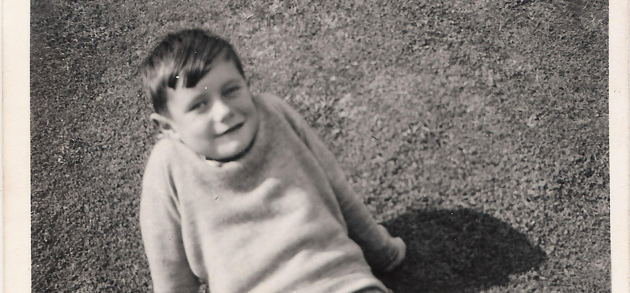
I was nine years old. I didn’t have any real friends, just the boy my father picked up each morning as he drove me to school, and this was only to make it look as though I had friends when he dropped me off. I never saw the boy then until the next morning and each day had to walk home by myself. He had red hair and became a butcher and judo champion. I spent all day in the smelly, snotty, sniffing classroom worrying about the journey home. My teacher was a friend of my father’s and his favouritism of me made my situation difficult—it caused me to worry. I worried about leaving through the school gates. I worried about trudging down the gutters in the road, keeping my head down in the hope I would not be seen. I worried about knowing the places where other boys would jump out and pick on me. I worried about being jostled by them, being pushed from one to the other. I worried about being called names and I worried about being injured. All day I worried about being treated as a favourite and worried about being alone for the journey home.
My mother, who was always telling me what to do, borrowed pay-weekly shopping catalogues from a neighbour who was an agent. Usually it was Kays but sometimes Littlewoods. It was only in later years that my interest was expanded when I discovered GUS and Empire Stores also published catalogues. They all had common factors: they were massive, heavy, glossy and had a whole section devoted to women’s bras and panties. I used to pore over this section whenever I sneaked some private time with the catalogue. I would spend hours with it if I could, always being careful not to mark the pages or bend the heavy spine back too much. I can still remember the models’ bodies, the colours of their tight pulled panties, their wonderfully filled lacy bras. I rarely looked at their faces but I fell in love with every one of them. They were the closest things I had to friends. I can still see them now—fixed in time, beautiful, immortal. And my excitement was amplified, given a sort of piquancy, when my mother called me to tea or shouted out from the kitchen “Gerald, where’s the catalogue?”
The other section I looked at was the watch section. For a time I was always in a state of desiring a watch. I pestered my mother incessantly. In the end when I was nine I was given the object of my desire—black faced, white strapped, gold buckled, exactly as it was on the page 846 of the Littlewoods catalogue. I don’t even know if it was a Timex or an Accurist. Probably an Accurist though that may be more a memory of the advertising tag line on Radio Luxembourg some years later, “And now the time by my Accurist watch is…”. Timex was of course American whereas all Accurist watches were assembled entirely from Swiss made components.
Although my mother told me I was not to wear my new watch to school, I harassed her constantly and sulked at every opportunity until she finally conceded it might be possible.
It was Friday. I was mixed up and in a rush—my mother constantly badgering me to be ready, my father waiting in the car with the engine running. That day my teacher put up on the back wall of the classroom a painting I had done—a range of spiky purple mountains painted on dark paper. He drew the class’s attention to its imaginative force as he compared it to the pitiful daubings of the others pinned up unevenly around it. I could not hide myself from the sneering of the class as he forced them to look behind them and concentrate on my exceptional work. My only other artistic effort that gained any approbation in school was a statue of a man, plaster of Paris on a wire frame—a sort of dripping man— that won a prize in the inter-house Dixon Cup competition in the third year of my grammar school education. These were the only two things that school praised me for; the only two occasions it credited me with any value in my imagination. For the rest of the time it tried to prise me into a container that I didn’t seem to fit. I hated school.
And so the day went on. It was winter and even in the mid afternoon the light was fading. Pellets of chewed up blotting paper hit the back of my head. I could feel the sneers and muttered snotty words that condemned me as a teacher’s pet, someone favoured, someone to be reviled. Desks banged as grubby books were put away for the weekend. Two whole days away from it all. I looked at my left wrist. I wanted to see how close it was to going home. I was already planning how I could wriggle past the knot of boys who would be clustered around the heavy wrought iron gate at the front of the school. I was already imagining how quickly I could make my way down the road towards home, perhaps getting enough ahead of them to avoid their shouts, the things they threw and their jostling. I stared at my wrist. It was bare. The watch was gone!
“Books away!” the teacher shouted and the desk lids were banged shut with emphatic finality. “Quietly!”
Titters at the back of the class. I turned and saw a hand reaching up towards my painting, threatening to pull it down or rip it. The face sneered at me—eyes wide and threatening. The boy, an ugly character with an overlarge head, pulled the end of his ruler back and flicked an imaginary missile at me. I ducked and he laughed.
I looked at my wrist again, thinking that something might have changed, that somehow the watch may have magically returned to its rightful place. It hadn’t. Slowly my hand went into the air, my arm outstretched.
“Yes?” asked the teacher.
I couldn’t speak. I tried but nothing would come out.
“What is it, Gerald? Come out here.”
I looked behind me again as I stood up. The threatening eyes were still on me. A sudden snatch at my drawing told me the threat against it, and against me, had not subsided.
I walked to the front of the class and stood next to the teacher’s high wooden desk. He nodded at me as though that would be enough to enable me to speak. It was not. A bell rang out and feet shuffled as we were now past the official going home time.
“Quiet!” roared the teacher. “Quiet!”
A numbing, pent up silence came over the room.
I bit my lips.
“Now, Gerald, what is it?”
“Sir...sir…”
“Yes, yes. What is it?”
I didn’t want to speak out. I didn’t want anyone else to hear me.
“Sir…sir, I’ve lost my watch.”
He nodded his head slowly.
“Gerald, go back to your seat.”
I walked back but even hanging my head could not prevent me seeing the looks of hatred from the held back class of enemies.
“Right,” said the teacher, talking his place at the centre and front of the class. “Gerald has lost his watch. Does anyone know anything about this?”
I stared ahead. I hated my name being spoken. I heard only feet shuffling. No response.
“Come on! Someone must know something about this. Speak up!”
No one spoke. More feet shuffled.
“Very well, you will all stay in until the watch is found. Gerald, you go and search in the boys' lavatories while we all wait here.”
I crept out of the room, not daring to look back as the class sat in silence, gripping their desk lids, fixing the back of my head with stares of hatred.
I crossed the empty playground and searched the boys’ lavatories—nothing more than a square wall with a gully running along one side and an opening for an entrance. The girls had already been let out next door. They were never in such a rush to get away as the boys. A group of them were on the other side of a steel gate and played tantalisingly behind it. At playtimes I hung around this gate listening to their shouts and laughter, their whooping and sometimes even their conversations—usually about boys. Sometimes a bare leg or just a white ankle sock and red sandal showed beneath the bottom edge of the gate but nothing else. Here, they were a foreign land, undiscovered and unknown, yet to be found and explored. Away from school it was different. They were my playmates. They showed me parts of their bodies and I showed them mine. I played with them for hours—in sheds, in hedges, behind fences and in the garage. It angered my mother. “Why can’t you be like your brother? You’re like a girl. You should be playing with boys!” Who wanted to play with boys? The thought of it revolted me.
I didn’t want to go back to the classroom but I knew I must. I put my head as low as possible as I lifted the door latch and went in. The class still sat at their desks. This time I could not avoid their stares. Everyone looked at me with loathing.
“Well, Gerald? Did you find it?”
“No, sir.”
“Then someone must know where it is.” He turned to the class. “I will ask you again. Does anyone know anything about Gerald’s watch?”
More silent stares. Whitening knuckles gripped the edges of the desktops.
“Then we shall sit here until it is found.”
I was ordered back to my seat.
I snatched a look through the high windows on the one side of the classroom. It had become dark. Spots of rain splashed against the glass. Every five minutes the teacher told the class that we would wait in our seats until someone owned up to the theft of the watch or gave information of its whereabouts.
Half an hour passed. The teacher beckoned me to come up to him. I went, scratching my knee painfully against the underside of my desk.
I stood in front of him, hardly able to contain my fears.
“Gerald, are you sure you were wearing the watch? Are you sure you came to school with it?”
“Yes. Yes, Of course.”
He looked up towards the rain splashed window.
“I think you should go home and check. If it is still at home then you can return and let us know. We will wait until you come back.”
He told the class what was happening, that I was going home to check if it was there, to check that I hadn’t mistakenly thought I was wearing it, that it wasn’t lost or stolen at all. He told them that they would remain in their seats until I returned.
I was dispatched. It was completely dark outside. It was marvellous to leave the school without having to push my way out of the gate past those that hated me. It was exciting to leave them all inside the school and feel the freedom of walking down the road without any threat or fear.
It was a long walk home, more than half an hour. When I arrived I was wet and cold. My mother scolded me as soon as I got inside the door. She shouted at me for being late, for being wet, for making her wait to give me my tea. She dragged my wet clothes from me and pushed me into the kitchen. She cut a plaster and stuck it on the graze on my knee. I sat at the table. It was warm.
“After all the fuss you made, you never even took your watch,” she said as she laid it down on the table in front of me.
I ate my tea and went to play in the front room. I got down behind the settee, lying out on the cream lino. I always felt comfortable here, behind the settee. I could play in any way I wanted. Everyone was seemingly oblivious to my existence—no one saw me, and I could listen in to conversations. I played with a Triang 00 gauge railway engine my mother had picked up for me at a Chapel rummage sale. It was plastic, not as good as a Hornby, but it ran across the lino well if I pushed it properly. My mother said she knew someone whose son wanted to get rid of some rails. Also, after my mother said I could leave the table, I had managed to sneak the latest Littlewoods catalogue from the shelf on the sideboard dresser. It had only been in the house for a week but already fell open at my favourite pages. I pushed my railway engine back and forth absently as I renewed acquaintance with my special friends.
In a while my father came home. The headlights of the car flashed across the room as he drove up and parked in front of the green timber garage. He was usually late and was always in a rush to eat and then get to a meeting of some sort. I saw very little of him. I spent more time with him on the drive to school than any other time. He went to get changed before he had his tea because, he said, he had to go to a meeting about the Chapel that had been brought forward because of the bad weather My mother busied to warm up his meal. There was a knock at the door.
I peered around the back of the settee as my mother went to answer it. She opened the door. A squall of rain came in as she drew the door back. A boy stood outside, one of the boys from the class—the boy with the overlarge head.
“I have been sent to find out if Gerald’s watch has been found?” he asked. “We have been waiting for him to come back and let us know.”