I’d driven with Don before—he was good fun, he told stories about girls, and pubs, and recounted amusing problems with loading livestock onto lorries. That’s what we were doing, taking a wagonload of calves to Kent—Crowborough, south of Royal Tunbridge Wells. Don was the driver, I was the driver’s mate.
It was a long way to go for both of us and we were excited at the prospect. Don was only a few years older then I, and married to a girl he’d met at school. The calves had been fed before they were driven out of the pens at the livestock market. They pushed against each other as they squeezed between the galvanized railings that held them in, their eyes wide open, looking in all directions, not knowing what their future held. Stockmen in white coats moved them on, flicking them with short sticks, and shouting to them in some sort of sub-human language—‘Yupeehuhah! Yupeehuhah!’. Their hooves clattered on the slatted ramp as they were squeezed into the back of the wagon. All had a label roughly stuck to their backs with the number of the purchase—‘56/455’. Now they all shared a common future, the future of all those designated ‘56/455’. Some of them let out distressed cries, some snorted, they all dribbled a steamy froth from their fleshy-lipped mouths, but whatever they did they could not escape being now part of the same family.
We were told they’d been watered and Don signed the slip of paper to put them all in our charge. We checked the open boarded sides of the wagon to make sure everything was secure. Long pink, steaming wet tongues lapped between the wooden bars.
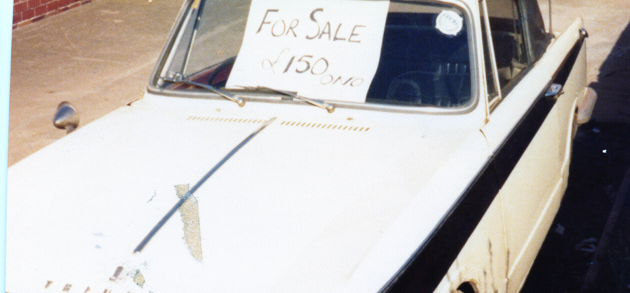
It was a good journey, setting off down the A5 towards London. Don told me a story of when he took a girl we both knew in school to the cinema. He recounted in graphic detail how he’d kissed her in the back row and how she’d screamed out when he got her long hair tangled in her impossible to undo bra strap. I laughed as though it was simply amusing, but I felt envious. I’d asked the same girl out twice and she’d said no on both occasions. Don said he was glad he’d got married—no problems with bra straps anymore! He said he’d got a problem with his car though, an old Triumph. The exhaust had broken at the joint with the manifold and he was keen to get it repaired while there was still some metal to work with. He said he’d get on with it when we got back. He’d only been able to afford it in the first place because his wife’s father had lent them the money to buy it.
The closer we got to London the busier it became. It was a strange progressive contrast to the country life from which we both came: Rugby, Leighton Buzzard, Hemel Hemstead, St Albans; all the time sinking into the heart of something gigantic, mysterious, overwhelming. We chatted about buzzards, and saints, and girls, and bra straps. More traffic, models of cars we’d never seen before, the closing in of buildings, the weight of people. Then a sign telling us that the North Circular Road was closed! Our route to the county of Kent was blocked! The only way of by-passing the urban darkness of London was unavailable!
We pulled over. Our livestock family broke into wailing. It was as if they knew our journey was impeded, or as if they sensed some terrible disaster ahead; as if they could hear the roaring waters of the Red Sea about to break in upon them. Some of them bleated louder and the rest followed, trying to join the orchestra of distress. Don said they’d need water soon. I thought of the salty Red Sea. The smell of them drifted into the cab. I could taste their terror on my dry lips. I imagined them desiccating or drying into chrysalises. Don said he knew a way through London. It was ‘no problem’ he said, ‘dead easy’. We’d give the cattle water when we got to the other side of the city.
And so we set off into the tight metropolitan urbanity of it all. At first it was exciting—the city streets, the signs to places we’d heard of but never seen, then into places we had heard of: Trafalgar Square, the Houses of Parliament, Big Ben. We towed our bellowing cargo around the city streets, black cabs racing around us, shovelling us into one lane and then another, pedestrians looking astonished at our long tongued passengers, and pulling back as the smelly, steamy creatures threatened the urbanites with their rurality. We circuited some islands twice, fighting for an exit as we lumbered our slowly desiccating load from sign to sign, building to building, groups of recoiling pedestrians to group of recoiling pedestrians. Don laughed at it all and I laughed with him.
But as the afternoon turned into early evening, and the light became less bright and the buildings more grey, a sense of worry drifted into the wagon’s cab. It mixed with the ever-increasing howling from the cattle, their acrid smell, and that they had been given no water since some time when they were penned up in the market stockyards before they had all been sold and labelled 56/455s. Then the two announcements from Don that came in quick succession—I’m not sure of the order in which they were delivered, but I remember exactly what they were: ‘We’re lost’, and ‘We’ve got no map’.
But we couldn’t stop, there was something about the pressure of it all, the movement of the city that kept us going. And the baying of our load got worse and in the mirror I could see desiccated tongues wagging through the railing of the wagon, lapping out perhaps in the hope of catching a few drops of city rain. It went dark—as if it were the tropics, suddenly in a moment it was dark. And everywhere were lights—burning, searching, penetrating lights, piercing the blackness, leading nowhere, providing no hope.
I don’t know how long it was, how long we were adrift in this anxious sea of loss but suddenly we stopped and stared, aghast, and open-mouthed as we looked up at a sign that hung above us. It was as if God had sent it down to show us where we were. It was yellow with black writing. It was shining in the light of bright lamps placed around it. It was silent but in every way it spoke—‘WELCOME TO HEATHROW AIRPORT’.
We drew the wagon up at the ‘Arrivals’, begged a bucket from a cleaner and found a tap. We gave water to our dehydrated family but it took hours. We drove back through the night. We stopped at a transport café. It was filled with smoke, leather waistcoated drivers, and the smell of fried food. I was holding the entrance door as we went in when it fell off its hinges and crashed sideways onto the floor. No one said anything. Some of the men looked up but straightaway returned to their food, or their cigarette, or their conversation, or their silent thoughtful moments of reflection away from their cab.
The same afternoon that we got back, the same afternoon that we lost our jobs, Don decided to get on with mending the exhaust on the Triumph. I said I’d call for him later and we’d go out to the pub for a drink—commiserate with each other. His young wife was making some cakes in the kitchen. He used the jack that his father–in-law had given him when he’d cleared out his garage—it was a red hydraulic trolley jack—the Wizard. He lifted the old Triumph as high as he needed and lying on his back slid beneath it. He felt comfortable there, working on something he understood, something he knew he could deal with, something he could repair. He found the rent in the rusty metal of the exhaust pipe. It was big and the system behind it had fallen almost free. He reached up to it and tugged at it. The jack rocked and he watched it as the weight of the old Triumph dislocated itself from the splayed knuckle of steel that supported it and slowly fell on top of him. It dropped on his chest. He saw it all, that strange slow motion of events that unfold when they are threatening life. He could hardly breathe and he couldn’t move. In the corner of his eye he saw his young wife’s feet. She placed a cup of tea and a plate with a cake on by his feet and entreated him to finish soon and come in for his meal. He stared ahead, unable to speak, looking at the break in the exhaust pipe wondering if it was beyond repair. Then he couldn’t breathe any more and he closed his eyes, exhaled and died.
The light was fading. It was late now, but still summer, still warm, still buzzing with insects. Dr Peace rounded the last corner on her moped, cigarette dangling from her mouth, its barely glowing end ready as an ember to light the next. Dr Peace—her first name never known though often the subject of conjecture. Dr Peace, her hair in a loose wind-blown bun—always willing to respond to any family crisis or call for help, clutching the handlebars of her NSU Quickly, with Rasper, her spaniel, curled up in a box attached to the rear carrier with loosely knotted hessian bag string. Rasper, always ready to accompany his mobile mistress and bark out sympathetic comments to the dying, or whine endorsement or dissent to old packages of drugs pulled from the peripatetic medic’s worn out brown leather bag.
But there was no care appropriate for Don; the only requirement was a piece of paper with a scrawled note of finality. Cigarette ash fell on the script as it was passed over to the young widow—“Suffocation due to crushing by heavy object”. Rasper growled his agreement with a hint of practised but still sincere sympathy. Don’s widow took the note, picked up the cup of tea and the cake and walked back from the garage into the house, not thinking of any of the details or even what she should do to have her crushed and now dead husband drawn out from beneath the murderous car. Rasper jumped back into his box. Doctor Peace pushed her moped down the drive to start it, then, throwing her leg high and jumping across the leather saddle with the zest of someone born into a new and novelty-promising life, she rode off down the road and into the tangled cloud of myriad summer evening insects.
With thanks to Rod